Vision

A well-balanced proposition
What does the user really need? What is technically and practically feasible? And how does the solution contribute to the organisation’s strategy, market position and commercial ambitions?
Within product development, these perspectives are often represented by different disciplines. I see design as having an important role in connecting them and making the consequences of choices visible.
This leads to solutions that are not simply attractive, technically clever or commercially interesting, but combine these qualities in a way that reinforces each of them.
The result is better-founded product decisions and a stronger basis for successful development and market introduction.

Early proof
Many important product decisions are made when relatively little is visible. At that stage, assumptions about users, technology, the market or production can lead to costly changes later.
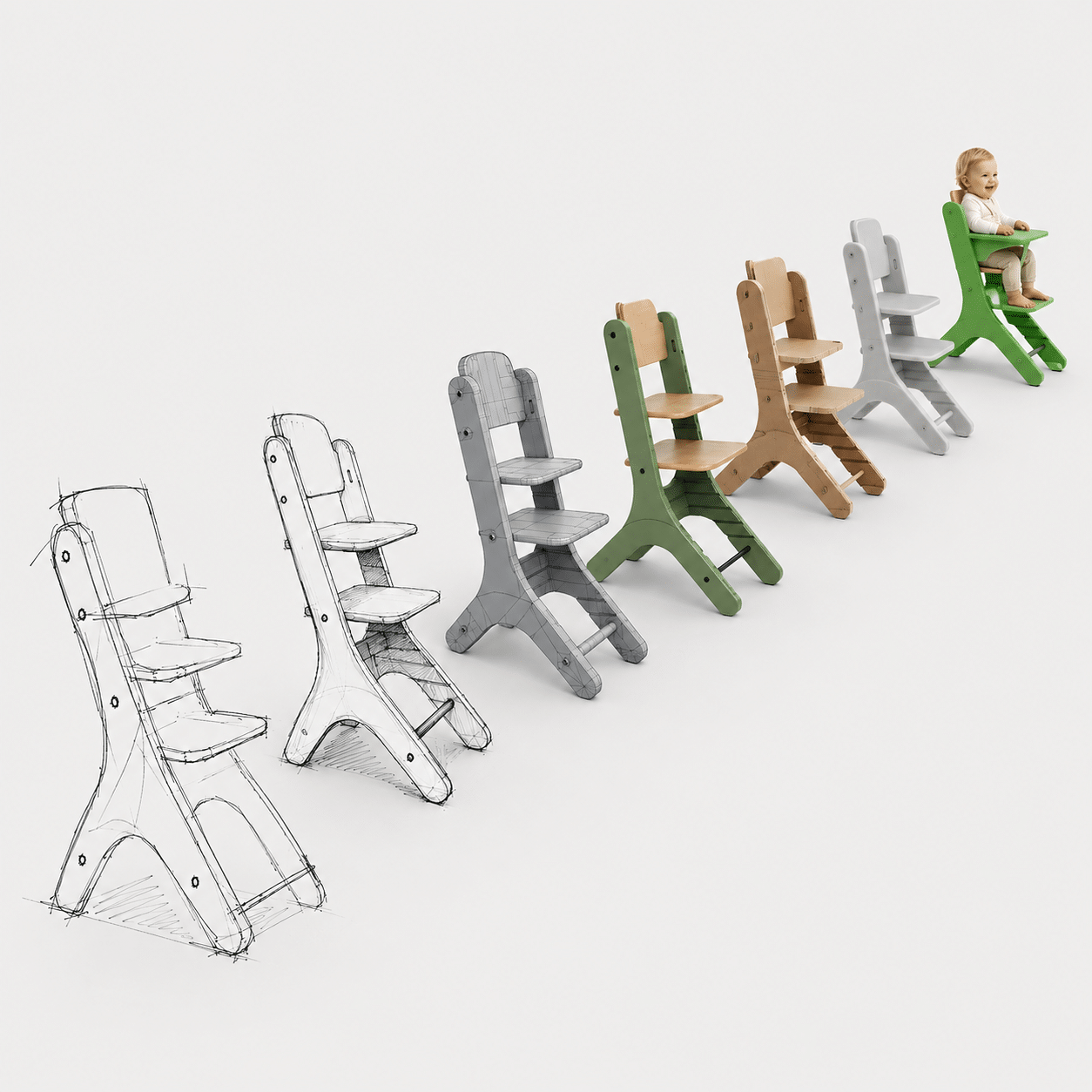
That is why I make ideas tangible as early as possible. Scenarios, sketches, visualisations, models and prototypes allow different directions to be explored before major development decisions are made.
By involving relevant expertise and stakeholders early, assumptions are shared, conflicts become visible sooner and solutions can be assessed from multiple perspectives.
The aim is not to remove uncertainty completely, but to ask the right questions at the right time and move to the next step with sufficient confidence.
This reduces false assumptions, builds stronger support for decisions and makes the development process more efficient.
Identity through design
A product says something about the organisation that developed it: its ambitions, quality, technical expertise and the way it thinks about its users.
For me, industrial design therefore goes beyond making a technical solution visually attractive. Form, materials, detailing, interaction and user experience should work together to express what the company and the product stand for.
That requires a distinctive design direction rather than simply following existing visual languages or trends. A strong product identity helps users understand and recognise a product and can also create coherence across a wider portfolio.
In this way, design becomes a visible part of an organisation’s positioning.
The result: products that not only work well, but are also recognisable, inspire confidence and create distinction in their market.
“Marnix succeeded in converting the overwhelming number of competing requirements to various viable solution directions, enabling WPS management to make optimal choices.”
Toine Meesters, former R&D Manager at WPS Parking Systems